
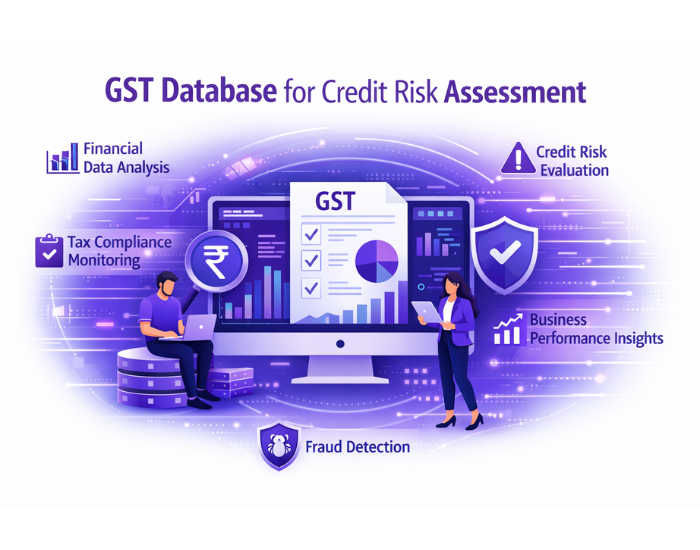
Use GST database for credit risk assessment. Analyze business data, detect risks, and make smarter lending decisions with GST insights.
Contact Us To Get Free Sample Database
Analyse the sample format before purchasing the database

Introduction
GST Database for Credit Risk Assessment is transforming how financial institutions, NBFCs, fintech companies, and businesses evaluate creditworthiness. Traditional credit assessment methods rely heavily on financial statements, credit scores, and limited historical data—often leaving gaps in accuracy and reliability. In contrast, GST data provides real-time, verified, and transaction-level insights directly sourced from GST filings, offering a more transparent view of a business’s financial health.
Contact Us To Get Free Sample Database
Analyse the sample format before purchasing the database
By analyzing GST returns such as GSTR-1, GSTR-3B, and e-way bill data, lenders can assess revenue trends, tax compliance, supplier relationships, and operational consistency. This enables a deeper understanding of borrower behavior, especially for MSMEs that may lack formal credit histories.
Modern GST database solutions integrate advanced analytics, AI, and automation to convert raw GST data into actionable insights. These tools help identify hidden risks, detect anomalies, and improve underwriting accuracy. As a result, businesses and lenders can make faster, data-driven decisions, reduce defaults, and enhance overall portfolio performance.

Why GST Database for Credit Risk Assessment is Important
Improves Credit Decision Accuracy
GST data offers verified and real-time transaction records, reducing dependency on manipulated financial statements.
Enhances MSME Credit Accessibility
Many small businesses lack formal credit history. GST data bridges this gap by providing reliable operational insights.
Reduces Lending Risk
Identify inconsistencies, irregular filings, and suspicious activities early to minimize credit defaults.
Provides Real-Time Business Insights
Track revenue trends, seasonality, and growth patterns for better financial evaluation.
Ensures Data Authenticity
GST filings are government-verified, making them more reliable than self-reported financial documents.
Supports Faster Loan Processing
Automated GST data analysis speeds up underwriting and approval processes.
Types of GST Database for Credit Risk Assessment Solutions
- GST Data Extraction & Analysis
Retrieve and analyze GST returns (GSTR-1, GSTR-3B) to assess turnover, tax payments, and compliance behavior. - Credit Risk Scoring Models
Generate AI-based credit scores using GST data, helping lenders evaluate borrower risk efficiently. - GST Compliance Monitoring
Track filing patterns, delays, and inconsistencies to assess financial discipline. - Supplier & Buyer Network Analysis
Evaluate business relationships and dependency risks through GST transaction networks. - Fraud Detection & Risk Flags
Identify anomalies such as fake invoicing, mismatched filings, and unusual transaction spikes. - Portfolio Risk Monitoring
Continuously monitor borrower portfolios using GST data for early warning signals. - API-Based GST Data Integration
Integrate GST insights directly into loan management and underwriting systems. - Custom Credit Intelligence Dashboards
Build tailored dashboards for lenders, fintechs, and enterprises to visualize credit risk insights.
Key Features of GST Database for Credit Risk Assessment
- Comprehensive GST Data Coverage
Access detailed GST returns, e-way bills, and compliance records for complete analysis. - AI-Powered Risk Assessment
Advanced algorithms evaluate creditworthiness and detect hidden risks. - Real-Time Data Processing
Instant insights for faster and more accurate decision-making. - Cross-Verification Capabilities
Compare GST data across filings to identify discrepancies and inconsistencies. - Automated Credit Reports
Generate detailed credit reports with actionable insights and risk scores. - Scalable Data Processing
Analyze large volumes of GST data for enterprise-level operations. - Secure & Compliant Data Handling
Ensure data privacy and compliance with regulatory standards. - Customizable Analytics
Tailor insights based on industry, geography, and lending requirements.
Development Process for GST Database for Credit Risk Assessment
- Requirement Analysis & Risk Modeling
Understand business needs, lending criteria, and risk parameters. - Data Source Integration
Connect with GST systems and authorized data providers for accurate data access. - Data Collection & Structuring
Aggregate and organize GST data into structured formats for analysis. - Data Cleaning & Validation
Ensure accuracy by removing inconsistencies and validating datasets. - Analytics & Risk Scoring Development
Build AI/ML models to assess credit risk and generate scores. - Dashboard & Reporting Development
Create user-friendly dashboards for visualization and reporting. - Testing & Quality Assurance
Validate system accuracy, performance, and reliability. - Deployment & Integration
Integrate with existing loan management and underwriting systems.
Technology Stack for GST Database for Credit Risk Assessment
- Backend Technologies: Node.js, Python, Java
- Frontend Technologies: React.js, Angular, Vue.js
- Database Systems: PostgreSQL, MongoDB, MySQL
- Cloud Platforms: AWS, Google Cloud, Microsoft Azure
- Data Analytics Tools: Power BI, Tableau, custom BI dashboards
- APIs & Integration: REST APIs, GraphQL
- AI/ML Frameworks: TensorFlow, Scikit-learn
- Security: Encryption, multi-factor authentication, role-based access control
Cost Factors in GST Database for Credit Risk Assessment
The cost of implementing GST-based credit risk solutions depends on:
- Volume of GST Data Analyzed
Larger datasets require more processing power and storage. - Level of Analytics & AI Integration
Advanced risk models and predictive analytics increase costs. - Real-Time vs Batch Processing
Real-time systems are more resource-intensive. - Customization Requirements
Tailored dashboards and workflows add to development complexity. - Integration with Existing Systems
Connecting with LMS, CRM, and ERP systems impacts cost. - Cloud Infrastructure Usage
Storage, computing, and scalability requirements influence pricing. - Compliance & Security Requirements
Enhanced security features may require additional investment. - Maintenance & Support Services
Ongoing updates and monitoring contribute to long-term costs.
Latest Trends in GST Database for Credit Risk Assessment
- AI-Driven Credit Underwriting
Automated risk evaluation using machine learning models. - Real-Time Risk Monitoring
Continuous tracking of borrower activity using live GST data. - Integration with Alternative Data Sources
Combining GST data with banking, bureau, and digital data. - Predictive Risk Analytics
Forecast potential defaults using historical GST patterns. - API-First Lending Platforms
Seamless integration of GST data into digital lending ecosystems. - Advanced Fraud Detection Systems
AI-based anomaly detection for identifying fraudulent activities. - Cloud-Based Credit Intelligence Platforms
Scalable and accessible solutions for lenders and enterprises. - RegTech Integration
Automated compliance and regulatory reporting using GST data.
Why Choose Us for GST Database for Credit Risk Assessment
Accurate & Reliable Data Insights
We provide verified GST data analysis to ensure precise credit risk evaluation.
Advanced AI & Analytics Capabilities
Leverage cutting-edge technology to uncover hidden risks and opportunities.
End-to-End Credit Intelligence Solutions
From data extraction to reporting and integration, we offer complete solutions.
Customizable Risk Models
Tailored credit scoring and analytics based on your business needs.
Scalable & Secure Infrastructure
Designed to handle large datasets with enterprise-grade security.
Seamless System Integration
Easily integrate with your existing lending and analytics platforms.
Dedicated Support & Expertise
Our team ensures continuous support, updates, and optimization.
We help lenders and businesses make smarter, faster, and safer credit decisions using GST data.
Ready to enhance your credit risk assessment with GST data?
Let’s build a powerful GST-based credit intelligence solution for your business.
Contact us today for a free consultation and customized quote.
Frequently Asked Questions
It is the use of GST data to evaluate a business’s financial health, compliance, and creditworthiness for lending decisions.
GST data enhances traditional methods but is typically used alongside credit scores and financial statements.
Yes, authorized and compliant access to GST data is permitted for analysis purposes.
Banks, NBFCs, fintech companies, and enterprises involved in lending or risk evaluation benefit the most.
It is highly accurate as it relies on verified and real-time government data.


